



Best Knee Cap for Pain Relief: What to Look For and Why Inflammation Is the Real Issue
Knee pain is one of the most common chronic pain complaints across all age groups — from runners dealing with patellofemoral syndrome to adults in their forties with early osteoarthritis and office workers with repetitive strain. The search for thebest knee cap for pain relief is understandable: a good knee support can meaningfully reduce pain during activity and give a painful joint the mechanical offloading it needs to function. But a knee cap alone does not change the underlying inflammatory environment that is making the joint painful in the first place. Understanding what is actually driving knee pain — and addressing it from both the outside and the inside — is what produces lasting improvement.
Table of Contents
- Table of Contents
- 1. Best Knee Cap for Pain Relief: What to Look For and Why Inflammation Is the Real Issue
- 2. What a Knee Cap Actually Does
- 3. Common Causes of Knee Pain
- 4. Inflammation as the Common Driver of Knee Pain
- 5. Anti-Inflammatory Botanicals for Joint Pain
- 6. Gut Health and Joint Inflammation
- 7. Clinical Insight: Boswellia and Knee Pain Reduction
- 8. Comparison of Knee Pain Relief Interventions
- 9. Expert Perspective on Knee Pain and Inflammation
- 10. Practical Steps for Long-Term Knee Pain Relief
- 11. Frequently Asked Questions
- 12. Conclusion:
Key Benefits
- What a Knee Cap Actually Does:
- A knee cap (also called a knee sleeve or knee brace depending on the design) provides compression, warmth, and proprioceptive feedback to the joint. Compression reduces swelling by improving venous and lymphatic return. Warmth increases local circulation, which supports tissue healing and reduces stiffness. Proprioceptive feedback improves joint position awareness, which reduces the risk of further injury and can meaningfully reduce pain during movement by giving the joint a more stable functional signal.
- A rigid brace with hinges provides direct structural support for ligament instability or post-surgical recovery. A compression sleeve is better suited for inflammatory or overuse knee conditions where proprioception and swelling management are the primary needs. The best knee cap for pain relief is the one that matches the specific mechanical problem — not necessarily the most expensive or most rigid.
Common Causes of Knee Pain:
Patellofemoral pain syndrome — pain around or behind the kneecap — is one of the most common causes of knee pain in active adults and is driven by a combination of patellar malalignment, quadriceps weakness, and overuse. Osteoarthritis involves cartilage degradation with secondary bone and synovial inflammation. Meniscal tears present with localised pain, locking, or clicking. Pes anserine bursitis is common in overweight adults and causes medial knee pain. Iliotibial band syndrome causes lateral knee pain in runners.
Each of these has a different mechanical component — but all share a common amplifier: inflammation. Whether the primary lesion is structural or not, the inflammatory environment of the joint determines pain severity and recovery speed.
Inflammation as the Common Driver of Knee Pain:
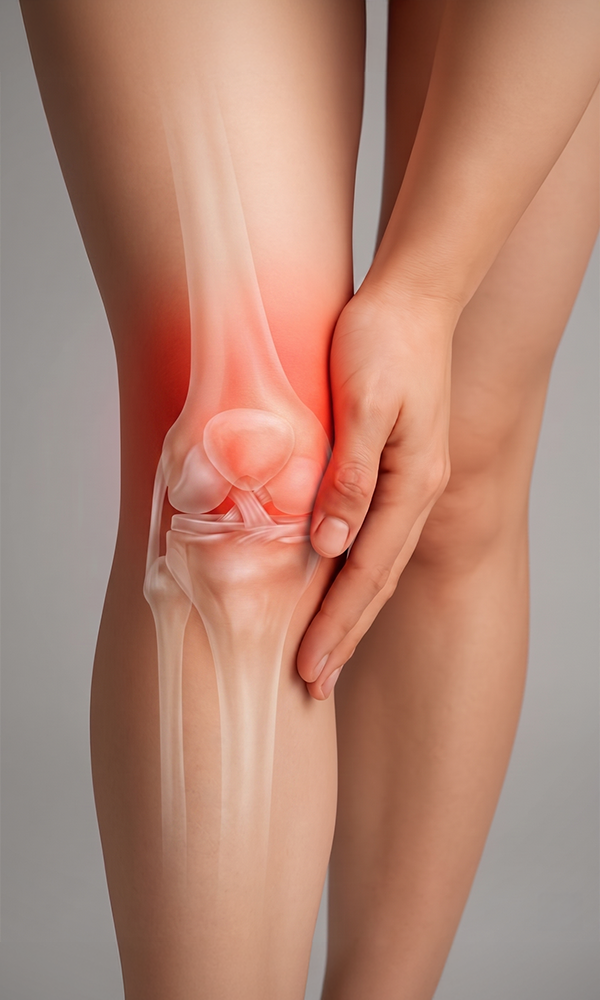
Joint inflammation in the knee involves synovial tissue activation, release of inflammatory cytokines (IL-1β, TNF-α), and sensitisation of nociceptors (pain receptors) in the joint capsule. This inflammatory environment amplifies pain signals beyond what the structural damage alone would produce. People with elevated systemic inflammation — from gut dysbiosis, high cortisol, poor sleep, or high-inflammatory diet — experience more severe knee pain for the same degree of structural change, and recover more slowly.
This means that reducing systemic and local joint inflammation is a meaningful intervention for knee pain — not just physiotherapy and mechanical support. The best medicine for joint pain framework includes both.
Anti-Inflammatory Botanicals for Joint Pain:
Boswellia serrata (Shallaki) has the strongest evidence base for osteoarthritic knee pain among botanical compounds. It inhibits 5-lipoxygenase — producing leukotrienes that directly drive synovial inflammation — and has been shown in multiple randomised controlled trials to reduce knee pain scores, improve walking distance, and reduce morning stiffness significantly versus placebo.
Curcumin inhibits NF-κB, a master regulator of inflammatory gene expression. Several head-to-head trials have compared curcumin formulations to ibuprofen for knee osteoarthritis, with comparable pain reduction at standard doses and a significantly better gastrointestinal side-effect profile. Ginger compounds provide complementary COX-2 inhibition. These three botanicals work through different but complementary inflammatory pathways, making combination approaches more effective than single-compound use.
Gut Health and Joint Inflammation:
The connection between gut microbiome health and joint pain is increasingly well documented. Gut dysbiosis drives systemic inflammation via LPS translocation, raising the systemic inflammatory baseline that amplifies joint pain. In rheumatoid arthritis research, specific gut microbiome signatures have been identified that precede and predict disease onset — pointing to gut inflammation as a root-level driver of joint disease. In osteoarthritis, elevated systemic inflammatory markers accelerate cartilage degradation and worsen pain severity.
Addressing gut health through microbiome restoration and reduced intestinal permeability is a genuine intervention in chronic joint pain — not an incidental wellness add-on.
In a randomised trial comparing Boswellia serrata extract to placebo in knee osteoarthritis patients, 70 percent of the Boswellia group reported clinically significant pain reduction at 8 weeks, versus 27 percent in the placebo group — with improvements in knee flexion range and walking distance alongside pain scores.
"A knee cap reduces pain in the moment by offloading the joint mechanically. But the inflammatory environment inside the joint is what determines whether that pain keeps coming back. Addressing both sides — the mechanical and the internal — is the only approach that produces durable relief." — Sports Medicine and Inflammation Research
Steps
- Choose a compression sleeve for general knee pain and swelling, a hinged brace only if you have documented ligament instability or are recovering from surgery
- Wear the knee cap during activity and for a few hours after — extended 24-hour wear reduces the proprioceptive benefit and can cause skin irritation
- Begin a boswellia and curcumin combination supplement and assess at six weeks — this addresses the inflammatory environment the sleeve alone cannot change
- Strengthen the quadriceps and hip abductors through seated leg extensions and clamshell exercises — quadriceps weakness is the most consistent modifiable risk factor for patellofemoral and osteoarthritic knee pain
- Reduce high-glycaemic foods and increase omega-3 intake to lower the systemic inflammatory baseline that amplifies joint pain
- Address gut health — fermented foods, prebiotic fibres, and reduced gut irritants — to reduce LPS-driven systemic inflammation contributing to joint sensitisation
Frequently Asked Questions
The best knee cap for pain relief is the one that matches your specific joint problem — and it works best when the internal inflammatory environment is addressed alongside the mechanical support it provides. A compression sleeve reduces pain in the moment. But it is the combination of appropriate mechanical offloading, anti-inflammatory botanical support, dietary changes, and gut microbiome restoration that shifts the inflammatory baseline and produces the kind of lasting knee pain relief that a sleeve alone was never going to deliver. Start with both sides of the equation — and the results are meaningfully better than either approach in isolation.